
A roof that only leaks during heavy rain is usually caused by clogged gutters or rainwater drains, cracked seams in the roof covering, or worn lead flashing. Water briefly rises higher and finds every weak spot. Catch the dripping water, cover the area dry where possible, and call a roofer quickly.
Why does my roof only leak in heavy rain?
A roof that stays dry during a light shower but suddenly starts leaking in a downpour is a familiar and frustrating problem. The explanation is almost always the same: during light rain the water drains away calmly, but during heavy rain the drainage system or the roof covering is briefly loaded more heavily than it can handle. The water rises a little higher or flows faster, and so it finds every small weak spot that goes unnoticed in normal weather.
Below we explain the most common causes, what you as a resident can do straight away, and how we fix a leak quickly and for good.
The most common causes
Clogged gutters and rainwater drains
This is by far the most common cause. Leaves, moss and dirt block the gutter or the rainwater drainpipe. During light rain the small amount of water still trickles past, but in heavy rain it cannot drain away fast enough. The gutter overflows, or the water rises behind the roof edge and creeps in under the roof covering. A blocked drain is therefore often the real culprit behind a “sudden” leak.
Cracked or detached seams in the roof covering
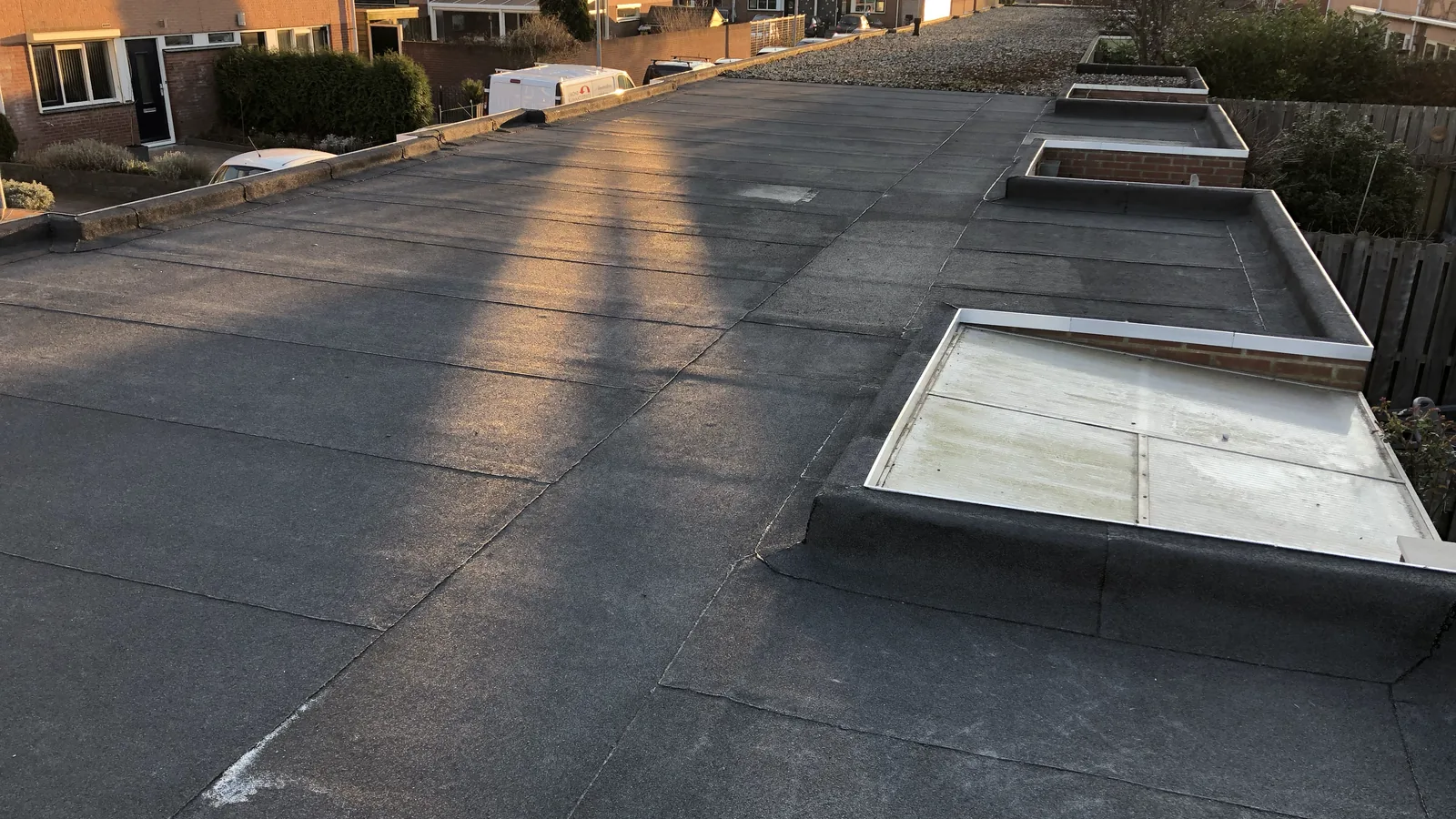
On flat roofs in bitumen or EPDM, the weak spots are in the seams and connections. Through ageing, expansion and contraction, seams can crack or come loose. With little rain it stays dry, but as soon as a layer of water remains on the roof, it forces itself in through the smallest crack. This is especially the case on older flat roofs that are due for maintenance or a renovation.
Capillary action and standing water
Water has the property of creeping “upward” through hairline cracks and small gaps, even against gravity. This is called capillary action. During heavy rain a thin layer of water sometimes remains on a flat roof or in a valley gutter. That standing water has all the time it needs to draw inside through a tiny crack or a poor connection.
Worn or cracked lead and zinc
Around chimneys, dormers, roof windows and wall connections there is lead flashing that keeps the roof watertight. Lead and zinc last for years, but can crack, lift or come loose. It is precisely at these connections that a lot of water passes during driving rain, so a small defect in the lead causes a leak straight away.
Damaged or shifted roof tiles
On a pitched roof, a shifted, cracked or missing tile can let water through in wind and heavy rain. Driving rain also blows water sideways under the tiles, where it normally never reaches. Sometimes the cause is also wood rot or a worn underlay.
What should you do straight away when there is a leak?
A leak in heavy rain calls for quick action to limit further damage. Here is what you can safely do yourself:
- Catch the water with a bucket or container and lay down towels to protect floors and belongings.
- Move furniture and electronics away from the wet spot and, if needed, switch off the relevant circuit at the fuse box.
- Carefully pierce a sagging, bulging ceiling with a container underneath, so the water drains in a controlled way and your ceiling does not collapse.
- Take photos of the damage, also for your insurer.
- Do not go onto the roof yourself during rain or a storm. A wet roof is dangerously slippery. Leave finding the cause to a roofer.
Want to know more about recognising and tackling damp in the home? Then also read our detailed article on the causes of roof leaks.
How we fix the leak quickly and for good
Tracing a leak is skilled work: the entry point on the inside is rarely directly below the real cause on the roof. That is why we always start with a thorough roof inspection to pinpoint the source exactly. We then solve the problem at its root, whether that is cleaning and flushing the drain, refinishing a seam, replacing lead flashing or repairing roof tiles. See our full approach on the roof leak and roof repair pages.
As a family business with more than 20 years of experience in the trade, we know that a leak cannot wait. We respond within 2 hours via WhatsApp and are often at your door within 24 hours, in Beverwijk and throughout North Holland and the surrounding area.
A temporary emergency repair is not enough
Sealing a leak with caulk or a cloth may look solved, but the real cause remains. At the next downpour it leaks again, often in a different spot, while the wood and insulation quietly stay wet in the meantime. A proper diagnosis and a clean repair are always more worthwhile than repeatedly treating the symptoms.
Is your roof leaking? Feel free to call us.
Do you have a leak right now, or are you unsure whether your roof can handle the next downpour? Get in touch with us without obligation via the contact page or send us a message. We think along with you, come round quickly and prepare a free quote with no strings attached. On our roofing work we give up to 15 years of warranty, so that after the repair you can look outside with peace of mind when it rains. With us, you are not just a number.
Last updated:
Frequently asked questions
During light rain the water drains away calmly, but in heavy rain the drainage or roof covering is briefly loaded more heavily than it can handle. The water rises a little higher or flows faster and so finds every small weak spot, such as a clogged gutter, a cracked seam or worn lead, that goes unnoticed in normal weather.
Catch the water with a bucket, lay down towels and move furniture and electronics. Carefully pierce a sagging ceiling bulge with a container underneath, so the ceiling does not collapse. Take photos for your insurer. Do not go onto the roof yourself during rain or a storm, as it is dangerously slippery.
We respond within 2 hours via WhatsApp and are often at your door within 24 hours. We are based in Beverwijk and active throughout North Holland and the surrounding area. With an acute leak, speed matters to prevent further damage to wood and insulation.
Sealing a leak with caulk or a cloth may look solved, but the real cause remains. At the next downpour it leaks again, often in a different spot, while the wood and insulation stay wet in the meantime. A proper diagnosis via a roof inspection and a clean repair are always more worthwhile than repeatedly treating the symptoms.