
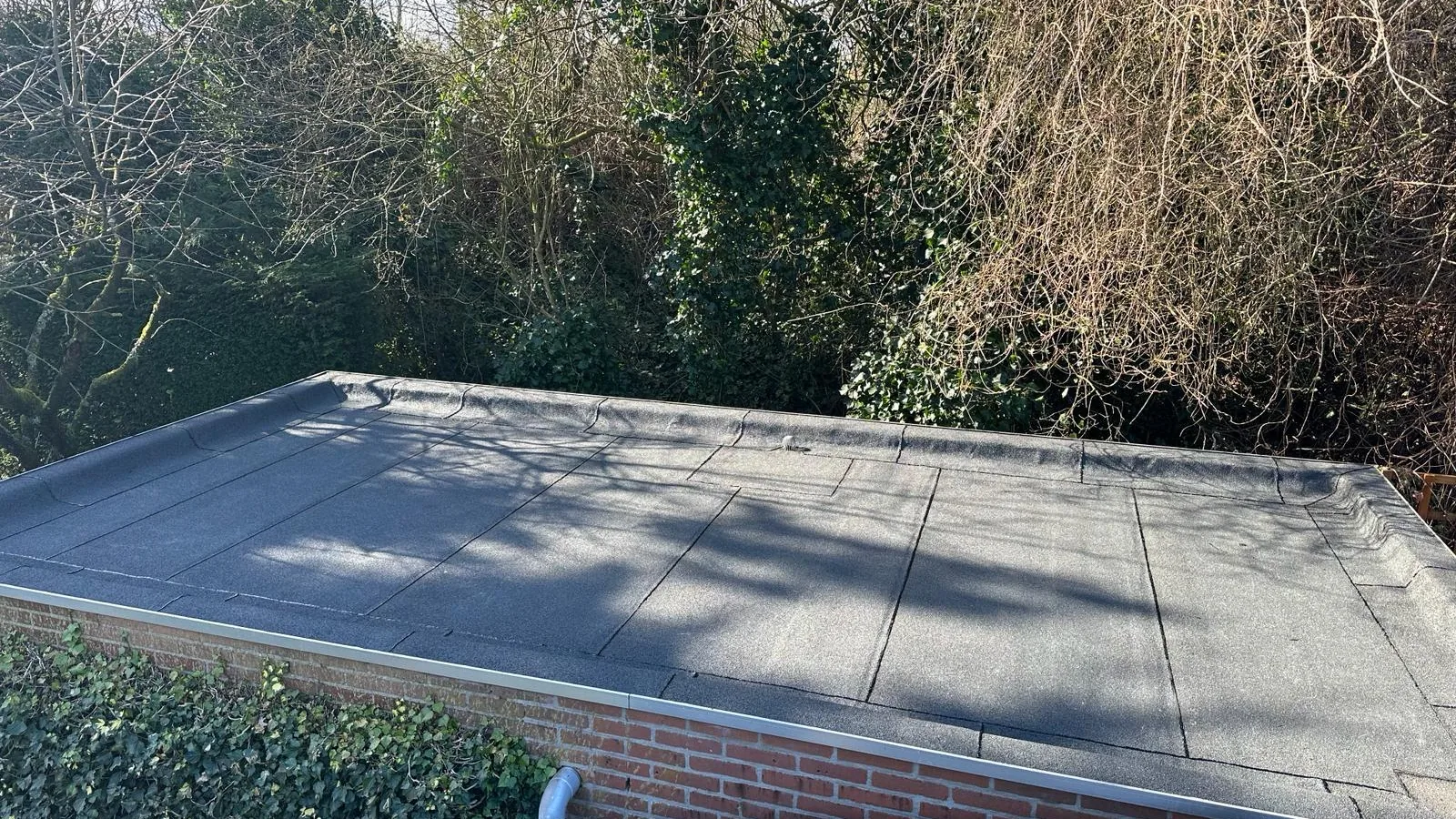
After storm damage to your roof, safety comes first: stay off the roof, cover the damage temporarily and take photos. Report the damage to your buildings insurance straight away and have a roofer draw up a repair report. We assess, document and repair the damage professionally.
What are the most common types of storm damage to a roof?
A strong storm always hits the roof first, because it is the most exposed part of your home to wind and water. The damage we see most often after a storm is easy to recognise:
- Blown-off or shifted roof tiles — especially at the ridge, the edges and above dormers, where the wind pulls hardest.
- Lifted or torn roofing membrane — on flat roofs the wind can get under the bitumen or EPDM and rip the sheets loose.
- Fallen branches or wind-blown objects that crack tiles, damage skylights or puncture the membrane.
- Leaks — often the first thing you notice indoors, as rain gets in through a hole or a displaced tile.
- Damage to gutters, lead work, the chimney and zinc work, which is easily overlooked but causes leaks later on.
What should I do immediately after storm damage?
The right first steps limit the damage and support your insurance claim. Follow this order:
1. Make safety your first priority
Never go onto the roof yourself during or right after a storm — wet, loose tiles and wind make that life-threatening. Keep your distance from hanging parts and fallen branches on the ground too. If there is a danger to the structure or to passers-by, call the fire brigade.
2. Capture the damage in photos
Photograph everything before anything is cleared away or repaired: the roof (safely from the ground or a window), loose tiles, water stains indoors and damaged belongings. These photos are crucial evidence for your insurer.
3. Cover the damage temporarily
Prevent further water damage by covering a hole or opening with a tarpaulin. Indoors, catch leaking water in buckets and move furniture and electronics to safety. Only do this if it can be done safely; otherwise call in a professional right away.
4. Call in a roofer quickly
The sooner an expert comes to look, the less consequential damage you face. We respond within 2 hours via WhatsApp and are often on site within 24 hours. For an acute storm-related leak, read more on our page about a roof leak.
How does buildings insurance work for storm damage?
Storm damage to the roof of your home is almost always covered by your buildings insurance (opstalverzekering). In the Netherlands, insurers define a storm as wind force 7 or higher. Good to know:
- Reporting: report the damage to your insurer as soon as possible and give a clear description with photos.
- Excess (eigen risico): storm damage often carries a separate excess per event; this is stated in your policy.
- Duty to limit damage: you are obliged to limit further damage, for example by covering it temporarily. Those costs are usually reimbursed.
- Repair report: the insurer almost always wants substantiation from a professional — what is broken, what caused it and what the repair involves.
Note the difference between sudden storm damage (covered) and damage from deferred maintenance or wear (usually not covered). That is exactly why a professional assessment matters so much.
How do we help with repair and insurance?
As a family business, we take the whole process off your hands. We start with a thorough roof inspection to map out all the damage — including the damage you cannot see from the ground. Then we provide clear documentation with photos and a repair report you can submit directly to your insurer.
Next we carry out the roof repair properly: from refitting or replacing tiles to re-bonding or overlaying a flat-roof membrane. On our roofing work you get up to 15 years of warranty, so after the storm you can rest easy under your roof again. With us you are never just a number — Tonnie, Jos and Noah handle it personally.
When is a repair enough, and when is it not?
| Situation | Repair | Replacement / renovation |
|---|---|---|
| A few blown-off tiles, roof otherwise sound | Yes, quickly resolved | Not needed |
| Local tear in bitumen or EPDM | Yes, spot repair | Not needed |
| Membrane lifted/old over a large area | Temporary only | Yes, overlay or renew |
| Persistent leaking or wood rot in the structure | Insufficient | Yes, renovation advised |
Not sure whether a repair will do? After inspection we give honest advice, with no obligation on your part.
Request help and a free quote with no obligation
Do you have storm damage to your roof? Send us a photo via WhatsApp — we respond within 2 hours and are often on site within 24 hours to safely cover and assess the damage. You receive a free, no-obligation quote with clear documentation for your insurance, and the repair comes with up to 15 years of warranty. Based in Beverwijk, active throughout Noord-Holland and the surrounding region.
Last updated:
Frequently asked questions
Yes, storm damage to the roof of your home is almost always covered by your buildings insurance (opstalverzekering). Insurers define a storm as wind force 7 or higher. Watch out for a possible separate storm excess and for the distinction: sudden storm damage is covered, while damage from deferred maintenance or wear usually is not. A roofer's repair report substantiates your claim.
No, we strongly advise against it. Wet and loose tiles, wind and height make the roof life-threatening right after a storm. Assess the damage safely from the ground or a window, take photos, and have a professional inspect the roof. We are often on site within 24 hours.
It depends entirely on the damage: the roof type (flat or pitched), the materials chosen, how many tiles or what area is damaged, accessibility and whether scaffolding or a cherry picker is needed, plus any consequential damage such as wood rot. We can only give an honest price after we have seen the roof. That is why you always receive a free, no-obligation quote, usually after a roof inspection.
We respond within 2 hours via WhatsApp and are often on site within 24 hours. For an acute leak or open damage we cover it temporarily first to prevent further water damage, and then schedule the permanent repair.